Interesting property of intersecting normal subgroups
I didn't think I'd talk about this either up until a few minutes ago.
The Romanian Maths Curriculum is extremely intriguing, mainly because of the fact that we do Analysis (at least Olympiad students do) and Linear and Abstract Algebra during our high school years. From what I've gathered, in College, we go again through these subjects in the first year, but at a more advanced level. The students who attended the Maths Olympiad during high school have a one year head-start over the ones that didn't, if you think about it, and that doesn't apply only for the Romanian Olympians who go to Universities in Romania. Participating at the Olympiad helps greatly in College, as the Olympians have more time to socialize and focus on extra-curricular activities during the first year, because they already know a lot of what the teacher is showing during the first few months. There is, however, a downside; only a few other people will have time to socialize with the Olympians, because in most Universities, there aren't a lot of people who already know a big chuck of the Curriculum.
I stumbled upon this group theory problem today, while going through a popular abstract algebra book. The problem itself, I think, is rather well known, but I discovered something that surprised me about the groups that the problem discusses.
Let \((G,*)\) be a group of order 2n, and \((H,*)\) and \((K,*)\) normal subgroups of order n such that \(H∩K={e}\). Prove that G is abelian.
Solution:
I shall prove that the only group satisfying these conditions is G={e, a, b, ab}, with \(a^2=b^2=e\), and a and b commute.
Since H and K have order n, and their intersection is e, their reunion has 2n-1 elements. Let x be the element that isn't in \(H∪K\). As a fun fact, since x isn't in \(H∪K\), \(x^{-1}\) isn't in \(H∪K\) either, because then x would be in either H or K, contradiction. Thus, \(x=x^{-1}\), so \(x^2=e\). This, however, doesn't really impact our proof. For the rest of the proof, we shall consider H* and K* as H and K minus {e}.
Let \(f_x:H^*⟶K^*\), \(f_x(h)=xh\). Obviously, this function is injective, and, since \(H^*\) and \(K^*\) have the same cardinal, it's bijective. Also, the function is well-defined, because \(xh\) can't be in H, because, if \(xh_1=h_2\), then \(x=h_2*(h_1)^{-1}\), so x would be in H.
Since the function is bijective, we have that \(xh_i=k_i\), for any i between 1 and n-1. Thus, \(x=k_i*(h_i)^{-1}=k_j*(h_j)^{-1}\), for any i and j between 1 and n-1, so \((h_i)^{-1}h_j=(k_i)^{-1}k_j\). The RHS belongs to H, and the LHS belongs to K, and we know that the only element of the intersection between H and K is e, so \(h_i=h_j=h, k_i=k_j=k\) for any i and j. Thus, H={e,h} and K={e,k}, while G is isomorphic with Klein's group: {e, h, k, hk}, and, as a fun fact, G is abelian, as required. The solution that the author of the book offered relied mostly on the fact that x has order 2, and that H and K were normal groups. The problem, as stated in the book, didn't say that H and K were normal subgroups, but rather asked you to prove that in the first part of the problem.
I've got to say, this result is a pretty intriguing property of Klein's group if you think about it. I truly hope that I didn't get anything wrong in the proof. Of course, this result pales in front of theorems such as the classification of simple finite groups, which took thousands of pages to write. However, it is a modest start. Tune in next time, for either another Analytical Geometry problem, another Probability problem, that personality article I kept talking about, or something totally random (again).
Cris.
An Old Problem from the Balkan Maths Olympiad
It was either this, or yet ANOTHER probability post. I thought of spicing things up a bit.
Here in Romania, coordinate geometry is described vaguely at the end of the 10th grade. I haven't seen exercises that involve thought in our curriculum regarding this subject, and, as an enthusiast of geometry, this saddened me, because analytic geometry is one of the stepping stones into University Mathematics. I managed to find coordinate geometry problems in MATs and STEPs, and, after a while, I managed to find one in the most prestigious Balkan competition: The Balkan Mathematical Olympiad. The problem I am about to solve is the 4th problem from the 1986 BMO. Like most other geometry problems, it has a synthetic solution, one which I will not discuss in this article. Frankly speaking, I like analytic solutions more than synthetic ones, because it gives me the rightful impression of manipulating real life objects (geometric figures) through numbers. The problem goes something like this:
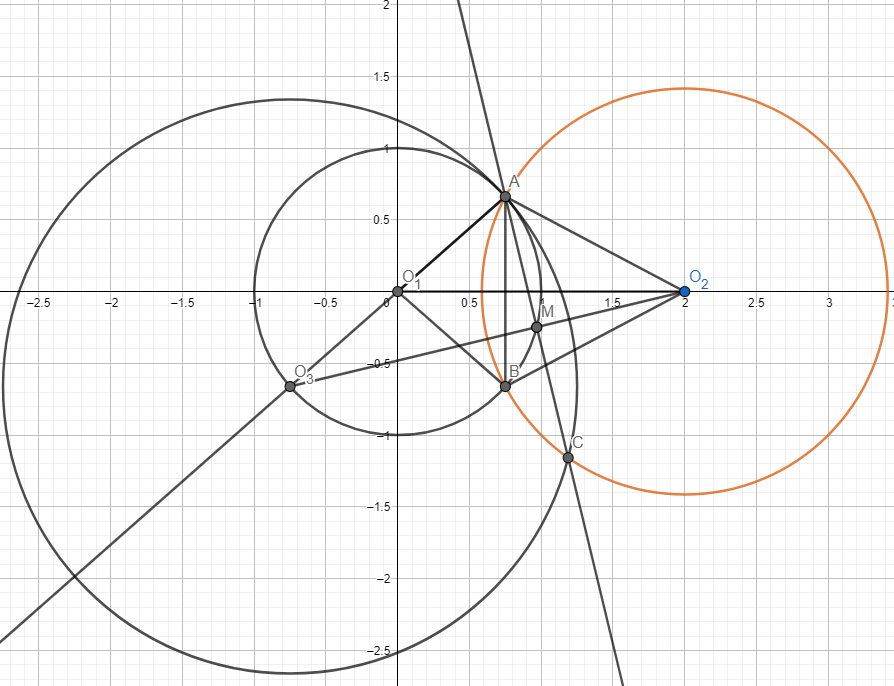
The circles \(K_1\) and \(K_2\), centered at \(O_1\) and \(O_2\), with radii 1 and \(\sqrt 2\), respectively, intersect at A an B. Let C be a point on \(K_2\) such that the midpoint of AC lies on \(K_1\). Find the length of the segment AC if \(O_1 O_2 =2\).
Solution:

Let us consider \(O_1\) as the origin of the Cartesian plane, and \(O_2 (2,0)\), \(A(x_a, y_a)\), \(B(x_b, y_b)\), \(C(x_c, y_c)\).
We shall look at the triangle \(AO_1O_2\). By the cosine theorem, we have that $$(AO_1)^2+(O_1 O_2)^2-2O_1O_2 * AO_1* cos(\angle AO_1O_2) = (AO_2)^2$$Thus, \(cos (\angle AO_1O_2)=\frac{3}{4}\), and, consequently, \(sin (\angle AO_1O_2)=\frac{\sqrt 7}{4}\). We now know that \(x_a=\frac{3}{4}, y_a=\frac{\sqrt 7}{4}\). Now that we know exactly where A is, we can take a closer look at C. Let M be the midpoint of AC. Since M is on \(K_1\), and \(x_m=\frac{x_a+x_c}{2}\), \(y_m=\frac{y_a+y_c}{2}\), we can use the equation of the circle to see that \(\frac{x_{c}^2}{4}+\frac{9}{16}+\frac {3x_c}{8}+\frac{7}{64}+\frac{y_{c}^2}{4}+\frac{\sqrt {7} x_c}{8}=1\), and, thus, \(x_{c}^2+\frac{3}{2}x_c+y_{c}^2+\frac{\sqrt 7}{2}y_c=3\). By adding 1, we have that C lies on the circle with equation \((x_c+\frac{3}{4})^2+(y_c+\frac{\sqrt 7}{4})=4\) This circle has center \(O_3 (-\frac{3}{4}, -\frac{\sqrt 7}{4})\), which is the diametrically opposite point of A in regards to the circle centered in \(O_1\). It is easy to observe that A is on the circle centered in \(O_3\) with radius 2, too, so AM is the height of the triangle \(AO_{3}O_{2}\). It is easy to find the cosine of \(\angle AO_2O_3\) through the cosine theorem. $$(O_{2}C)^2+(O_2O_3)^2-2O_2O_3cos(\angle AO_2O_3)=(O_3C)^2$$and, thus, the required cosine is \(\frac{3}{4}\). Consequently, we can find \(sin(\angle AO_2O_3)=\frac {\sqrt 7}{4}\). We shall now calculate the area of \(AO_2O_3\) in two different ways. We know that $$S_{AO_3O_2}=\frac{AM*O_3O_2}{2}=\frac{AO_2*O_2O_3*sin(\angle AO_2O_3)}{2}$$
$$⟹AM=\frac{\sqrt 14}{4} ⟹ AC=\frac{\sqrt 14}{2}$$.
It was pretty surprising to find such a problem in an international Maths competition. As I said, analytic geometry isn't really discussed in the Romanian curriculum, and, from what I've seen, isn't really part of the curriculum of contests either. The thing with analytic geometry is that, at an advanced level, it's a bridge between analysis, topology and other fields of Mathematics. The importance of Geometry is obvious by looking at the Millennium Prize Problems: the Poincare conjecture. While it's proof doesn't involve Geometry per-se, its implication is partly geometrical. I have a lot of ideas for the next article, but I think that I will either write an article about Jungian psychology (new tag boys!), or I will solve a very interesting probability problem that I found in the Step 2 from last year. Or, and this one is most likely, I will decide the subject on the spot.
Cris.
Here in Romania, coordinate geometry is described vaguely at the end of the 10th grade. I haven't seen exercises that involve thought in our curriculum regarding this subject, and, as an enthusiast of geometry, this saddened me, because analytic geometry is one of the stepping stones into University Mathematics. I managed to find coordinate geometry problems in MATs and STEPs, and, after a while, I managed to find one in the most prestigious Balkan competition: The Balkan Mathematical Olympiad. The problem I am about to solve is the 4th problem from the 1986 BMO. Like most other geometry problems, it has a synthetic solution, one which I will not discuss in this article. Frankly speaking, I like analytic solutions more than synthetic ones, because it gives me the rightful impression of manipulating real life objects (geometric figures) through numbers. The problem goes something like this:
The circles \(K_1\) and \(K_2\), centered at \(O_1\) and \(O_2\), with radii 1 and \(\sqrt 2\), respectively, intersect at A an B. Let C be a point on \(K_2\) such that the midpoint of AC lies on \(K_1\). Find the length of the segment AC if \(O_1 O_2 =2\).
Solution:

Let us consider \(O_1\) as the origin of the Cartesian plane, and \(O_2 (2,0)\), \(A(x_a, y_a)\), \(B(x_b, y_b)\), \(C(x_c, y_c)\).
We shall look at the triangle \(AO_1O_2\). By the cosine theorem, we have that $$(AO_1)^2+(O_1 O_2)^2-2O_1O_2 * AO_1* cos(\angle AO_1O_2) = (AO_2)^2$$Thus, \(cos (\angle AO_1O_2)=\frac{3}{4}\), and, consequently, \(sin (\angle AO_1O_2)=\frac{\sqrt 7}{4}\). We now know that \(x_a=\frac{3}{4}, y_a=\frac{\sqrt 7}{4}\). Now that we know exactly where A is, we can take a closer look at C. Let M be the midpoint of AC. Since M is on \(K_1\), and \(x_m=\frac{x_a+x_c}{2}\), \(y_m=\frac{y_a+y_c}{2}\), we can use the equation of the circle to see that \(\frac{x_{c}^2}{4}+\frac{9}{16}+\frac {3x_c}{8}+\frac{7}{64}+\frac{y_{c}^2}{4}+\frac{\sqrt {7} x_c}{8}=1\), and, thus, \(x_{c}^2+\frac{3}{2}x_c+y_{c}^2+\frac{\sqrt 7}{2}y_c=3\). By adding 1, we have that C lies on the circle with equation \((x_c+\frac{3}{4})^2+(y_c+\frac{\sqrt 7}{4})=4\) This circle has center \(O_3 (-\frac{3}{4}, -\frac{\sqrt 7}{4})\), which is the diametrically opposite point of A in regards to the circle centered in \(O_1\). It is easy to observe that A is on the circle centered in \(O_3\) with radius 2, too, so AM is the height of the triangle \(AO_{3}O_{2}\). It is easy to find the cosine of \(\angle AO_2O_3\) through the cosine theorem. $$(O_{2}C)^2+(O_2O_3)^2-2O_2O_3cos(\angle AO_2O_3)=(O_3C)^2$$and, thus, the required cosine is \(\frac{3}{4}\). Consequently, we can find \(sin(\angle AO_2O_3)=\frac {\sqrt 7}{4}\). We shall now calculate the area of \(AO_2O_3\) in two different ways. We know that $$S_{AO_3O_2}=\frac{AM*O_3O_2}{2}=\frac{AO_2*O_2O_3*sin(\angle AO_2O_3)}{2}$$
$$⟹AM=\frac{\sqrt 14}{4} ⟹ AC=\frac{\sqrt 14}{2}$$.
It was pretty surprising to find such a problem in an international Maths competition. As I said, analytic geometry isn't really discussed in the Romanian curriculum, and, from what I've seen, isn't really part of the curriculum of contests either. The thing with analytic geometry is that, at an advanced level, it's a bridge between analysis, topology and other fields of Mathematics. The importance of Geometry is obvious by looking at the Millennium Prize Problems: the Poincare conjecture. While it's proof doesn't involve Geometry per-se, its implication is partly geometrical. I have a lot of ideas for the next article, but I think that I will either write an article about Jungian psychology (new tag boys!), or I will solve a very interesting probability problem that I found in the Step 2 from last year. Or, and this one is most likely, I will decide the subject on the spot.
Cris.
The Probability of Passing a Test
Have you ever attended a test without studying anything whatsoever before it? Well your boy Cris is here to tell you something: you most certainly failed. Or, at least, you would have most certainly failed in a world fully governed by A-level Mathematics. I managed to find last year's STEP today, and I decided to take a look at some of the problems. Apart from the tedious, VERY TEDIOUS calculations, I found a nice problem that many people will emphasize with. This problem was the last Probability exercise in Step 1 last year.
A multiple-choice test consists of five questions. For each question, n answers are given
(n > 2) only one of which is correct and candidates either attempt the question by choosing
one of the n given answers or do not attempt it.
For each question attempted, candidates receive two marks for the correct answer and lose
one mark for an incorrect answer. No marks are gained or lost for questions that are not
attempted. The pass mark is five.
Candidates A, B and C don’t understand any of the questions so, for any question which
they attempt, they each choose one of the n given answers at random, independently of their
choices for any other question.
(i) Candidate A chooses in advance to attempt exactly k of the five questions, where
k = 0, 1, 2, 3, 4 or 5. Show that, in order to have the greatest probability of passing
the test, she should choose k = 4 .
(ii) Candidate B chooses at random the number of questions he will attempt, the six
possibilities being equally likely. Given that Candidate B passed the test find, in
terms of n, the probability that he attempted exactly four questions.
(iii) For each of the five questions Candidate C decides whether to attempt the question
by tossing a biased coin. The coin has a probability of \(\frac{n}{n+1}\) of showing a head, and
she attempts the question if it shows a head. Find the probability, in terms of n, that
Candidate C passes the test.
Solution:
(i) The probability of getting a correct answer to a question is \(\frac{1}{n}\). If k is smaller than 3, then the passing score isn't achieved in any scenario, so the probability of passing for k<3 is 0.
If k=3, then the probability is \(\frac{1}{n^3}\).
If k=4, then the probability of passing is \({4}\choose{3}\)\(\frac{n-1}{n^4}+\frac{1}{n^4}=\frac{4n-3}{n^4}\).
If k=5, then the probability of passing is \( {5}\choose{4}\)\(\frac{n-1}{n^5}+\frac{1}{n^5}\). In the last case, the minimum number of possible correct answers is 4, because otherwise the passing mark isn't achieved. Let us now compare the probabilities we found.
$$\frac{4n-3}{n^4}>\frac{1}{n^3}⟺4n-3>n⟺n>1$$.
$$\frac{4n-3}{n^4}>\frac{5n-4}{n^4}⟺4n^2-3n>5n-4⟺4(n-1)^2>0$$
Thus, the biggest probability of passing is when k=4.
(ii) We shall use Bayes' theorem for this one. Bayes' theorem states that, if we want to calculate the probability that the even B happens given that another event A happened before, then the probability required is \(P(B|A)=\frac{P(B⋂A)}{P(A)}\). Thus, the probability of B passing is $$P(k=4|pass)=\frac{P((k=4)⋂pass)}{P(pass)}=$$
$$=\frac {\frac{4n-3}{n^4}}{\frac{5n^2+2n-4}{n^5}}=$$
$$=\frac{4n^2-3n}{5n^2+2n-4}$$
(iii) \(P(C|pass)=\frac{10n^3}{(n+1)^5}*\frac{1}{n^3}+\frac{5n^4}{(n+1)^5}*\frac{4n-3}{n^4}+\frac{n^5*(5n-4)}{n^{5}*(n+1)^{5}}=\frac{25n-9}{(n+1)^5}\).
The problem itself was rather easy, and the calculations were simple enough to be done quick enough. The Step this year had some really interesting geometry problems, and, from what I've heard, had a monster algebra problem. While I find Step questions insanely interesting, I find the calculations required a bit tedious.
I attended a contest similar to the one described in the problem when I was younger. I am pretty sure many kids across the world, too, participated at the Mathematical Kangaroo competition. It was a rather good mental exercise for kids, in which you were asked to solve 30 questions in an hour and a half or something. I never did good in multiple choice tests, so I didn't have insanely good results at it; if I recall correctly, I once started crying desperately in one such contest, and the teacher assisting us was afraid to take my paper when the time concluded. Yikes!
Cris.
Subscribe to:
Posts (Atom)